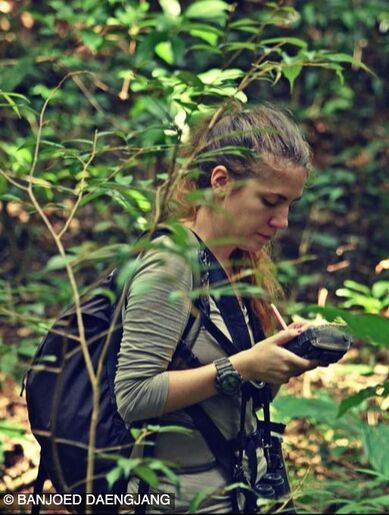
My research explores why animals form social relationships, and who they form them with.
I study mostly wild populations, using behavioural observations, social network analyses and non-invasive genetics.
Currently, I am taking a cross-species comparative approach to study how socio-ecological factors shape social relationships in macaques.
I study mostly wild populations, using behavioural observations, social network analyses and non-invasive genetics.
Currently, I am taking a cross-species comparative approach to study how socio-ecological factors shape social relationships in macaques.
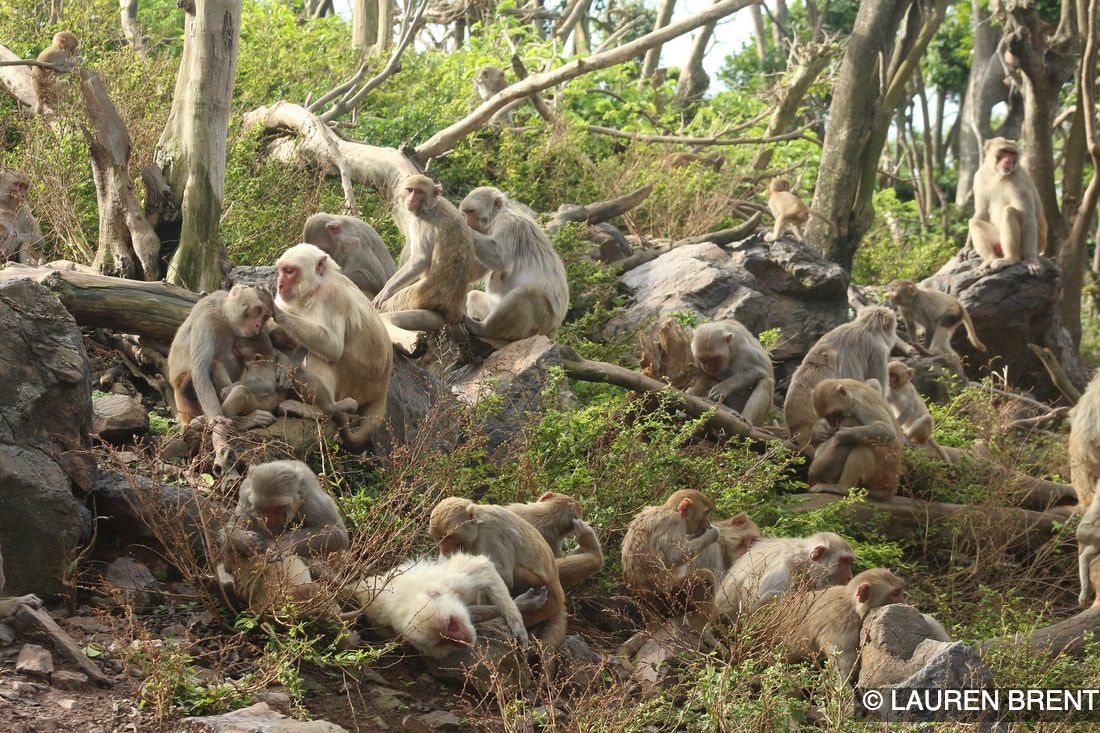
THE EVOLUTIONARY ORIGIN OF FRIENDSHIPSocial bonds, or friendships, allow individuals to live healthier, longer lives, yet the reason why these relationships are beneficial remains unclear. To better understand the evolutionary origin of social relationships, and to uncover the mechanisms linking sociality to fitness benefits, I take a cross-species comparative approach across all well-studied macaque species. Macaques show the same basic patterns of social organisation, but display broad interspecific variation in their social style. By studying these differences in sociality using social network analysis, and linking them to socio-ecological factors such as intra-group relatedness and competition, we can test which type(s) of social connectedness are adaptive, and why. This project is part of the FriendOrigins project (ERC Consolidator Grant 864461), exploring the evolutionary origins of friendship. Our analsyses use the collaborative MacacqueNet database, built and maintained by Christof Neumann & Lauren Brent, Julie Duboscq and me. |
|

|
KIN BIASES IN SOCIALITYKinship has a profound influence on the social life of animals, with affiliation and agonistic support biased towards closely related individuals in a wide variety of species. Kin biases are especially strong between maternally related females. Females are usually the philopatric sex, and spend their entire lives in their matriline. Because of this, maternal kin are easily recognisable and readily available, making them ideal bonding partners for both direct and indirect fitness benefits. What happens when kin recognition is less reliable, or when kin are not the most competent partner available, so that direct and indirect fitness benefits are not aligned? To answer these questions I focused on two less-studied aspects of kin biases in sociality: paternal kinship and the role of kinship in male sociality for my PhD. I studied kin biases in sociality in the wild Assamese macaques of the Phu Khieo Wildlife Sanctuary, with Julia Ostner and Oliver Schülke at the Behavioral Ecology Department of the University of Göttingen and Christian Roos at the Primate Genetics lab of the German Primate Center (DPZ). |
PATERNAL KIN BIASESFemales often mate with multiple males, so that paternity is concealed, which in turn hampers paternal kin recognition. I am interested in whether paternal kin biases in social behaviour can still develop, and what potential paternal kin recognition mechanisms might be operating.
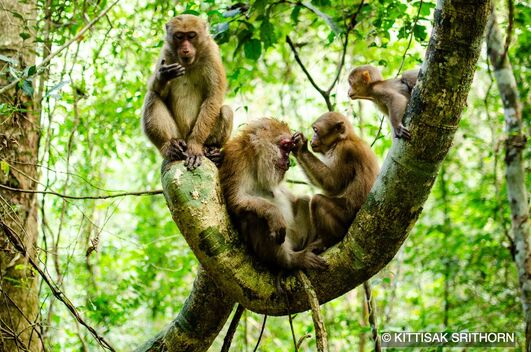
Female Assamese macaques bias their affiliation to maternal and paternal kin. De Moor et al., Behavioral Ecology, 2020 |
KIN BIASES IN MALE SOCIALITYDespite strong mating competition, males can benefit from forming strong bonds with other males in the group, who act as allies in risky coalitions for dominance ranks. I explore how relatedness, familiarity and partner competence interplay in male partner choice, and whether unfamiliar kin can recognise each other as such.
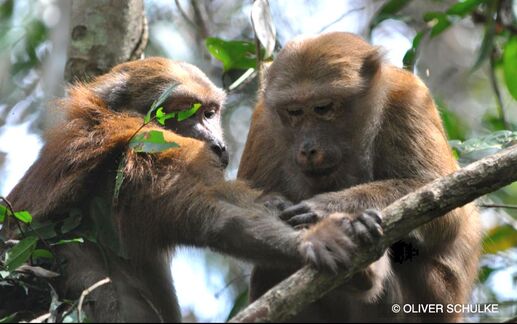
Affiliation is kin biased in male Assamese macaques, but males can choose non-kin over close kin to bond with. De Moor et al., Molecular Ecology, 2020 |
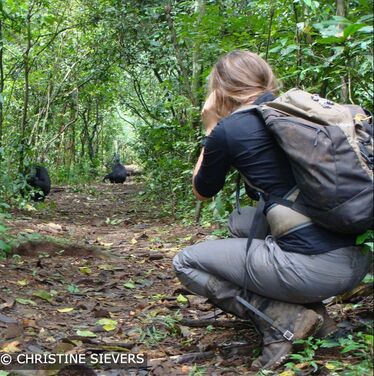
THE ROLE OF ECOLOGICAL FACTORS IN THE EMERGENCE OF TOOL USEWhat lies at the origin of behavioural innovations, such as tool use in chimpanzees? Novel behaviours might emerge in times of food scarcity, with animals forced to turn to less accessible food sources to meet their nutritional needs. On the other hand innovations might occur because key tool materials are encountered at the right spatio-temporal circumstances. I was part of a project on the role of necessity and opportunity in the emergence of tool use, with Cat Hobaiter and Thibaud Gruber. I carried out ecological surveys to collect data on available food sources and tool materials in three neighbouring chimpanzee communities in the Budongo Conservation Field Station. At the same time I managed the habituation and behavioural data collection on one of the communities. |
|
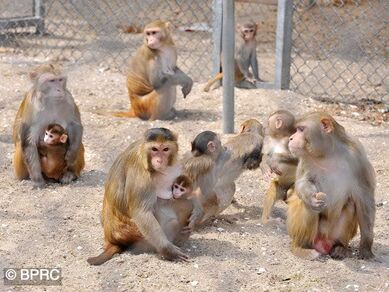
Male grooming is not exchanged for direct mating access in a mating market, but male-female relationships predict mating access in a group of captive rhesus macaques.
|
MALE MATING TACTICS: "FRIENDSHIPS" AND THE MATING MARKETMale mating success can depend on several factors, including dominance, the formation of "friendships" with females and the exchange of services for mating access. Males might use grooming in the exchange for sex in a mating market, or on a longer timescale to develop a relationship with a female which results in preferential mating access. For my master's thesis, I studied male grooming and mating patterns to explore mating tactics in a captive group of rhesus macaques at the BPRC. I was supervised by Liesbeth Sterck at the Animal Ecology department of the University of Utrecht. |
FUNDING & SUPPORT
|

|


|